 Tech Billionaires’ Craziest Inventions—And Which Ones Might Actually Save the World
Tech billionaires don’t just launch “revolutionary” apps anymore—they’ve moved on to reinventing reality itself. Today’s tech titans dream far bigger than social platforms or sleek gadgets. They’re experimenting with private mini-nuclear reactors to power future cities, designing AI systems that could rewrite how societies function, and even building floating, self-governing micronations in the middle of the ocean. What once sounded like sci-fi now shows up in patent filings, investor decks, and real construction sites.
Some of these projects promise clean energy, medical breakthroughs, or radical climate solutions. Others feel like billionaire-sized vanity quests, bold experiments with unpredictable consequences. Either way, they’re happening—funded, prototyped, and inching toward reality.
Here’s a guided tour through ten of the wildest ideas currently under development, each one strange enough to sound fictional yet serious enough to potentially reshape the world as we know it.
Elon Musk’s brain-chip “Neuralink” experiment
Neuralink is Musk’s brain-computer interface company that implants a chip with super-thin electrodes into the brain to read neural activity and send it to a computer. In early 2024, Musk said the first human patient, a paralyzed man, had fully recovered from surgery and could move a computer mouse on a screen with the power of thought, which is crazy, if true.
In a later case, a paralyzed woman used the implant to write her name on a screen for the first time in about 20 years, again by controlling a cursor purely with her mind. And the most recent example was a man controlling a flying drone. Despite the short-lived success and the drone’s crash, small victories like these hold significance. Neuralink’s stated goal is to help people with severe paralysis communicate and interact with computers more easily, with longer-term ambitions like treating neurological conditions.
Jeff Bezos’s orbital “space greenhouse” plan
Bezos’s long-term Blue Origin vision borrows heavily from physicist Gerard O’Neill: giant rotating space habitats with artificial gravity, parks, farms, and, of course, greenhouses in orbit. In public talks, he’s described these as self-sustaining colonies where heavy industry and manufacturing could move off-world, leaving Earth mainly for people and light industry.
He has repeatedly argued that all heavy, polluting industry should ultimately be done in space to keep Earth, this beautiful gem of a planet, clean. Blue Origin isn’t building full O’Neill cylinders yet; for now, it’s focused on orbital rockets and lunar infrastructure, but those concepts are the stated endgame.

Mark Zuckerberg’s VR metaverse revamp
In 2021, Mark Zuckerberg rebranded Facebook as Meta, declaring its future as the “metaverse,” a move that initially confused many. Meta was positioned as an immersive, 3D social internet you access mainly through VR and AR headsets. The Reality Labs division that builds this hardware and software has burned astonishing amounts of cash. By the end of 2024, it had racked up about $69 billion in cumulative losses, with relatively modest revenue. Despite facing criticism, Meta persists in investing billions in VR headsets, AR glasses, and its Horizon Worlds platform, with Zuckerberg consistently asserting that 2025 will mark a significant shift in the metaverse experience and user engagement.
Larry Page’s secretive “flying car” startup
Google co-founder Larry Page quietly bankrolled several electric “flying car” projects, starting with Zee Aero in 2010, later rebranded as Kitty Hawk. The company experimented with ultralight personal air vehicles and the Cora aircraft, an autonomous electric vertical takeoff and landing (eVTOL) design. Cora was eventually spun out into Wisk Aero, a joint venture with Boeing now focused on self-flying, zero-emissions eVTOL air taxis.
Kitty Hawk itself shut down in 2022, but Wisk continues development and aims to bring an autonomous passenger aircraft to market as part of the wider “advanced air mobility” sector.

Sam Altman’s crypto-powered “Worldcoin” ID project
Sam Altman, the CEO of OpenAI, co-founded Worldcoin with the goal of establishing a global “proof of personhood” system. This system involves individuals staring into a metal device known as the Orb, which scans their iris and generates a unique digital ID. Subsequently, they may receive crypto tokens linked to this identity, a concept that blurs the boundary between utopia and dystopia.
The project has run into serious regulatory trouble. Spain’s data protection authority ordered Worldcoin to delete all iris-scan data collected in the EU, citing violations of GDPR, and a Spanish court upheld a temporary ban on the project. Other regulators, including those in Brazil and Kenya, have also suspended or closely scrutinized operations due to privacy and consent concerns.

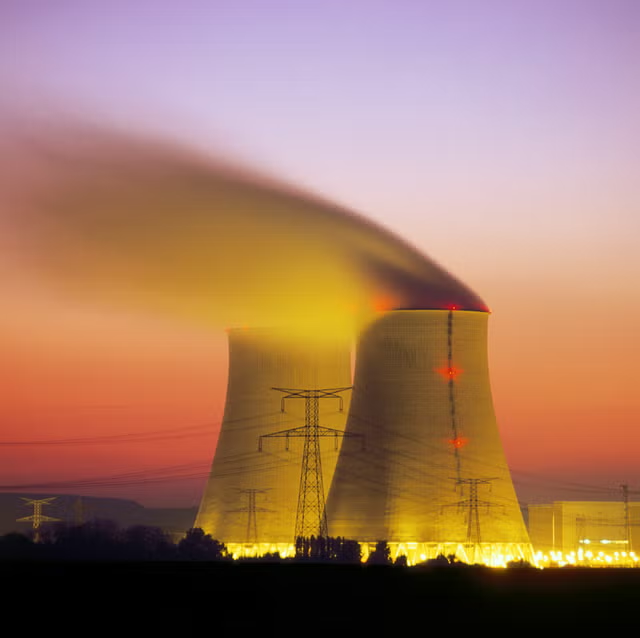
Bill Gates’s next-gen mini nuclear reactors
Bill Gates co-founded TerraPower, which is building a sodium-cooled fast nuclear reactor called Natrium. The design pairs a smaller, advanced reactor with a molten-salt energy storage system, so the plant can ramp power output up and down to complement wind and solar.
In June 2024, construction began on the first Natrium demonstration plant near Kemmerer, Wyoming. This is the first advanced reactor project in the U.S. to move from design into actual construction. Gates has framed it as a potential tool for decarbonizing the grid while providing reliable baseload power in former coal communities.
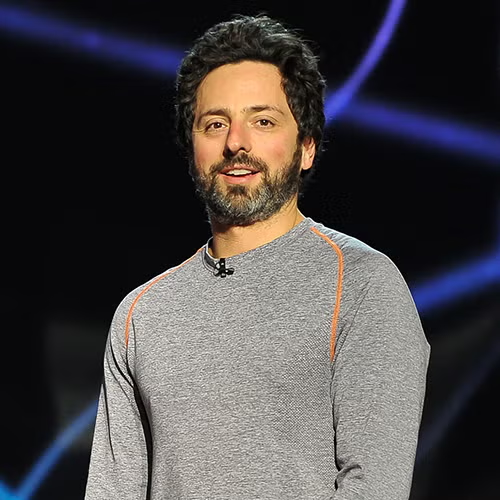

Sergey Brin’s giant “airship of the future”
Another Google co-founder, Sergey Brin, is reviving the concept of airships as low-emission cargo and disaster-relief platforms in his LTA (Lighter Than Air) project. Its first baby, “Pathfinder 1,” is a 124-meter helium airship built at NASA’s Moffett Field. In late 2024, LTA confirmed the aircraft’s first free flight at Moffett Field. In May 2025, the airship made its first public flight over the San Francisco Bay Area, showcasing a future where large cargo airships deliver supplies to remote or disaster-stricken regions, using less fuel than conventional aircraft.


Peter Thiel’s floating “seastead” micro-nations
The Seasteading Institute, founded in 2008 and partly funded early on by Peter Thiel, promotes the idea of permanent, politically autonomous communities floating in international waters. One headline project was a proposed floating city off Tahiti, made of modular concrete platforms with housing, offices, and sustainable infrastructure. The project stalled amid political and public pushback, and large-scale seasteads have not materialized so far. The idea, however, remains a touchstone in tech-libertarian circles: trying out different governance models by literally sailing away from existing nation-states is an interesting way to solve quite a few potential problems.

Jensen Huang’s planet-scale AI supercomputer farms
NVIDIA CEO Jensen Huang often describes next-generation data centers as “AI factories” whose main product is tokens—the units of text, images, or other data that AI models generate. NVIDIA’s Blackwell GPU architecture and related systems are explicitly marketed as building blocks for these AI factories, designed to run massive generative AI workloads.
The company is backing this rhetoric with huge infrastructure plans: from U.S. AI supercomputer “factories” in Texas to a roughly $100 billion partnership with OpenAI to build large AI data centers providing around 10 gigawatts of compute capacity. Huang has argued that, over time, most big companies will operate both traditional factories and AI factories side by side.

Masayoshi Son’s trillion-sensor “internet of everything”
SoftBank CEO Masayoshi Son has been talking about a world filled with connected devices for years. After acquiring chip designer ARM Holdings, he predicted that by around 2035, there could be 1 trillion Internet-of-Things devices generating data, which would include everything from sensors and smart appliances to industrial machines. Son has also said he expects ARM-based chips to power roughly 1 trillion IoT chips over 20 years. This project could be either absolutely amazing for the development of humanity or throw us back into the Dark Ages.