 Historical “What Ifs” That Might Change How You See the World
Alternate history is pure brain candy—sweet, addictive, and impossible to resist once you start chewing on it. Sure, you can’t prove any of it, but that’s not the point. The thrill comes from asking simple “what ifs” that spiral into worlds completely unlike our own. What if one battle had gone the other way? What if a key invention had never been created or had arrived centuries earlier? Suddenly, history veers off course, and you’re standing in a version of reality that feels both familiar and unsettlingly strange.
Some imagined timelines are outright terrifying: dystopian societies ruled by regimes that never fell, or worlds where progress is halted in its tracks. Others are surprisingly appealing—visions of peace, prosperity, or technology that bloomed earlier than expected. Most, though, fall somewhere in between, with fascinating blends of wonder and horror that make you question how fragile our “real” history truly is.
The best part? You don’t need a time machine or a PhD to enjoy it. All you need is curiosity and a willingness to play with possibilities. So, here are a few bold “what ifs” to snack on—and who knows? They might just change the way you see the past.
What if Columbus never discovered the Americas in 1492?
Before you pounce on that title, yes, he didn’t technically “discover” a land already full of people, but his voyages opened the door for Spain and the rest of Europe. If he’d never sailed or failed, someone else eventually would have liked Portugal, for example, whose ships were already racing around Africa and into India. Someone would’ve stumbled into the Caribbean soon enough. The Columbian Exchange (plants, animals, diseases, people) still happens, just later and differently. Maybe Europe waits longer for potatoes and tomatoes; maybe Indigenous empires like the Aztec and Inca last longer or even expand, but they still would not stand a chance against muskets and ship cannons. If Spain’s presence shrinks, the Dutch, English, and French are likely to likely carve out more, and their relationships with Native peoples might tilt a bit more toward trade than conquest. However, the colonization attempts most likely wouldn’t stop.
What if the Berlin Wall never fell?
The Wall’s 1989 collapse wasn’t just a dramatic TV moment; it symbolized the broader unraveling of Soviet-style communism. Gorbachev’s “perestroika” and “glasnost” helped soften the relations, and revolutions were already rolling through places like Poland and Hungary. If that famous border mix-up hadn’t happened, the Wall might’ve lasted a few more years. And with that, the USSR might’ve held together for a bit longer, or maybe it would have split faster. No empire ever lasts forever, but some historians think that the Soviet Union made the world more stable.

What if William the Conqueror whiffed in 1066?
William’s win at Hastings reshaped England: castles everywhere, Norman officials in charge, a new paper trail (hello, Domesday Book), and French mixing into English until the language became the glorious, illogical soup we know and love today. If Harold had survived and the Anglo-Saxons had kept power, England likely would’ve stayed more Germanic in speech and custom. Political fractures were already there, Viking pressure was real, and without Norman castle-building and legal reforms and the mortifying bureaucracy, England would’ve stayed more old-school. English might sound closer to Dutch or German, and a lot of later “English” institutions would feel very different.
What if Alexander the Great lived longer?
Alexander the Great died in 323 BCE during his leisurely stroll home from India. He had plenty of time to sketch out new campaigns, roads across North Africa, grand building projects, and a plan to mix populations. If he survived, he might have pushed his way into Europe. Having a kid could have also prevented his empire from splintering. Some historians even argue that a unified Alexandrian super-state could’ve blocked Rome’s rise and altered Christianity’s spread. Without Rome, we’d see a different Europe and a very different religious landscape. There could have been significant repercussions from a single outbreak.
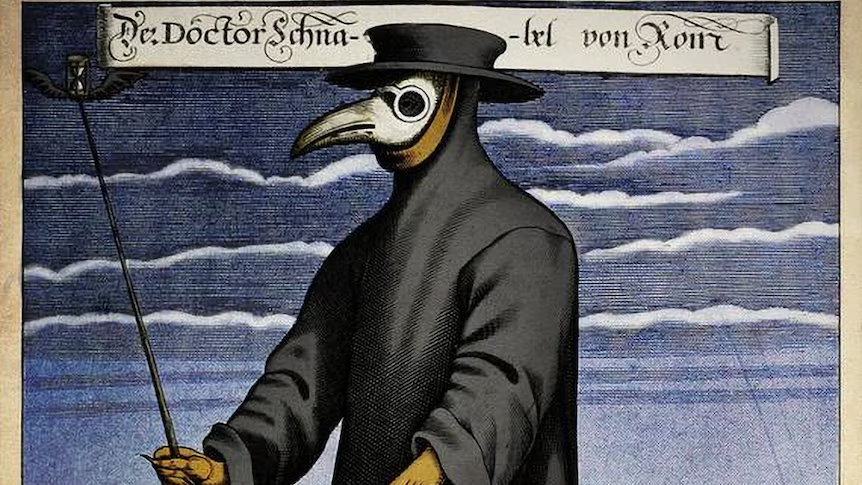
What if the Black Plague never happened?
One of the worst things that ever happened to Europe was the Black Plague in the 14th century. Millions perished, yet the survivors unexpectedly received higher wages for their labor, leading to the growth of cities. The sanitation department got a big injection of funds and researchers, and the industry in general got a nice buff. The plague also influenced things like art and religion. People began to perceive that the church and God were merely empty promises. If the disaster hadn’t struck, those millions of people would likely continue living in poverty, while the rich would continue to get richer. Worst of all, the Industrial Revolution could potentially be delayed by decades. It’s kind of a lose-lose, no matter how you spin it.

What if the Confederacy won the American Civil War?
Plenty of fiction has tried to reimagine this one. A Confederate victory likely means a permanently split North America with a slave-holding, agrarian South struggling to industrialize, and a smaller United States up north. The South’s economy would still revolve around cash crops, creating pressure to expand its labor system and possibly look farther south for resources and people. Globally, a divided America would wield far less power. That ripples into the world wars (if they happen the same way) and almost certainly reshapes the Cold War. The 20th century’s balance of power would look nothing like the one we know.
What if Franz Ferdinand survived Sarajevo?
The 1914 assassination is the cliché “spark” for World War I, but the gunmen almost blew it multiple times. If the archduke hadn’t been shot right then and there, things would have been different. He was pro-peace and didn’t want to go to war with Russia, which could potentially doom the whole of Europe. Without World War I, the Austro-Hungarian, German, and Ottoman empires would not have collapsed as fast as they did, and the hatred that helped fuel World War II would have been greatly reduced. Nationalism would still simmer, but the 20th century could’ve been far less apocalyptic.
What if the U.S. hadn’t dropped atomic bombs on Japan?
This scenario is still highly debatable. There are those who think that Hiroshima and Nagasaki being bombed helped to end the war faster and saved lives. And then there’s the opposition camp, which claims (rightfully so) that it’s morally wrong to kill civilians, even if the means justify the goal. The war would probably continue regardless of that, resulting in a massive invasion and millions of casualties on both sides, if the US hesitated. Negotiations could have prevented immediate atomic deaths and radiation effects. However, if the Soviets publicly demonstrated nuclear capability first, the Cold War would still occur.