 10 Most Realistic Medical TV Shows Ever
Medical dramas have been running on TV for decades. They give us life-or-death emergencies, moral gray areas, and of course, the chance to guess if it’s finally Lupus or just another case of the common cold. But while most shows take major liberties for the sake of drama, like all those “defibrillator” scenes, a few stand out for actually trying to get medicine right.
From battlefield surgery to obstetrics, here are the top 10 TV shows that give a surprisingly real look at life in medicine.
The Pitt
The Pitt has quickly become one of television’s most realistic portrayals of emergency medicine. Created by R. Scott Gemmill and starring Noah Wyle, the series unfolds over a single 15-hour shift at a fictional Pittsburgh trauma hospital—each of its 15 episodes representing one tense, chaotic hour. This real-time structure immerses viewers in the relentless pace and pressure faced by ER staff.
What distinguishes The Pitt is its attention to authenticity. Writers and producers consulted doctors and nurses throughout development, building cases around realistic scenarios and stripping away typical TV gloss. The absence of background music, for example, underscores the raw intensity of a ward where every second matters. Beyond medical accuracy, the show captures the emotional and systemic challenges of healthcare: burnout, understaffing, and the lingering aftershocks of the COVID-19 era.
Scrubs
What is this goofy sitcom with dream sequences doing on a “realistic” list? Believe it or not, Scrubs is regularly cited by healthcare workers as one of the truest shows about medicine. Sure, J.D.’s daydreams are pure comedy, but the way the show portrays hospital hierarchy, long shifts, using dark humor to cope with the hard stuff, and the sting of losing patients hits home. Creator Bill Lawrence tapped his med school buddy Dr. Jonathan Doris for accuracy, which is why Scrubs quietly nailed the real emotional rollercoaster of becoming a doctor.
House MD
Dr. Gregory House might be TV’s worst boss, but medically, the show holds up(-ish). House focused on rare, complex cases that real doctors might encounter once in a career. Its big strength was accuracy in the diagnostic process: ruling things out, testing hypotheses, and challenging assumptions. Doctors grumbled about the timeline (weeks of tests crammed into 42 minutes) and, of course, no real hospital would tolerate House’s behavior. But the logic and science behind the medicine were surprisingly solid.

The Knick
Steven Soderbergh’s The Knick proves medical realism isn’t just about the modern-day hospitals. Set in the early 1900s, it shows just how brutal and experimental medicine used to be. Clive Owen’s Dr. Thackery leads the charge in a world without antibiotics, modern anesthesia, or even clean water and reliable sanitation. Surgeries are historically accurate, which means they’re graphic, brutal, and often deadly. Medical historians love the detail, and viewers can’t help but wince and praise the science of modern medicine.
This Is Going to Hurt
Based on Adam Kay’s bestselling memoir, this 2022 TV show is a ruthless depiction of what it’s like to be the victim of Britain’s National Health System. Ben Whishaw plays a junior OB-GYN juggling impossible workloads, crushing bureaucracy, and the emotional fallout of mistakes. Real-life British doctors confirm that the show accurately depicts the realities, particularly the challenges of saving lives within an overburdened system. It’s funny, it’s painful, and it might just make you want to hug your doctor.

St. Elsewhere
Before ER, there was St. Elsewhere. Running from 1982 to 1988, this gritty drama focused on a Boston teaching hospital nicknamed “St. Elsewhere.” It was not afraid to tackle taboo issues, including being one of the first shows to deal directly with the AIDS crisis. The series also nailed the dynamics of teaching hospitals: attendings, residents, and med students constantly dealing with authority, exhaustion, and limited resources. It paved the way for every medical drama that followed.

MASH
While many viewed it as a humorous sitcom rather than a medical drama, MASH was remarkably accurate, especially for the era of the 70s and 80s. It illustrated surgeons making the most of their limited resources in close proximity to the front lines. Real military physicians commended its portrayal of battlefield surgery, the psychological impact of continuous trauma, and the dark humor that soldiers relied on to cope. And of course, it gave us one of TV’s most heartbreaking finales ever.
Getting On
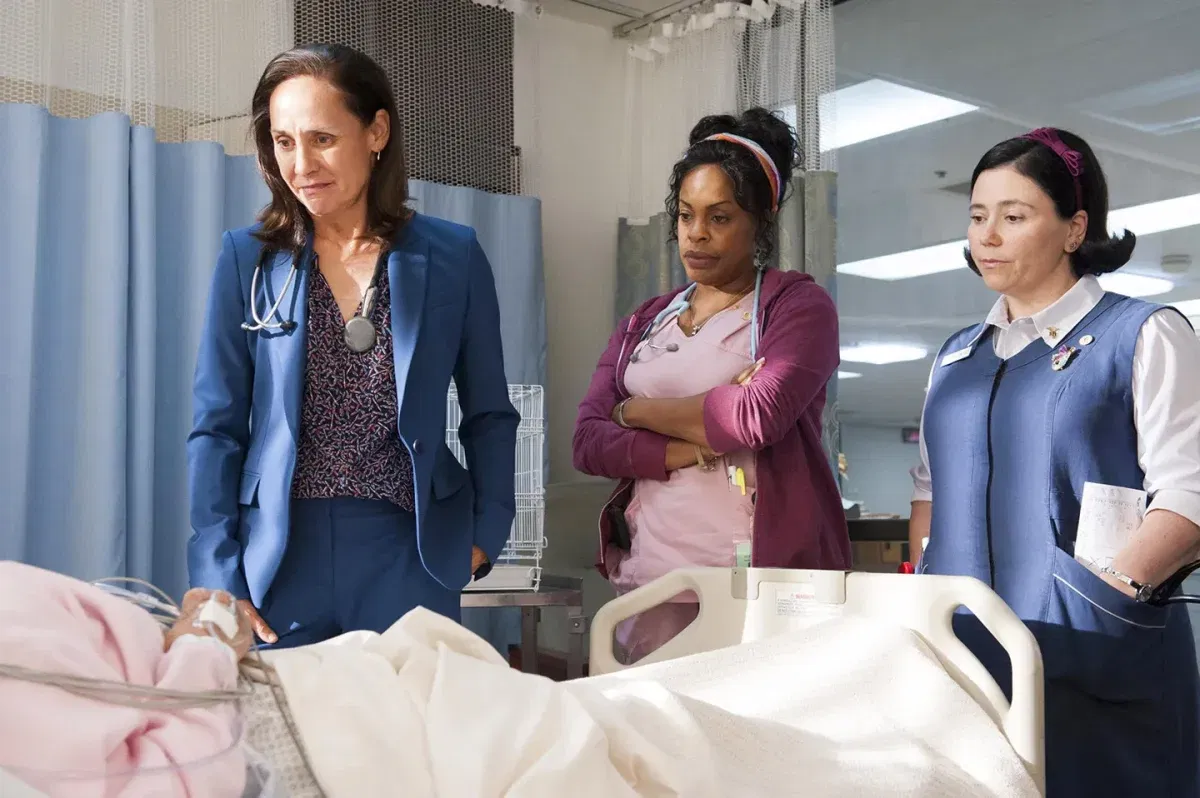
One of the most underrated entries on this list, and also one of the least popular medical topics on TV, HBO’s Getting On tackled geriatric and end-of-life care. Set in a run-down ward, it found both humor and humanity in caring for elderly patients. Critics loved how it dealt with the unglamorous realities of medicine: dementia, paperwork, and exhausted nurses doing their best with very little. Healthcare workers in geriatrics have praised it for finally giving their world some spotlight.

Lenox Hill
Want realism with zero Hollywood filter? Go watch Netflix’s Lenox Hill. It follows four real-life doctors at New York’s Lenox Hill Hospital: two neurosurgeons, an ER physician, and an OB-GYN. In this Netflix gem, they show you every nitty-gritty detail, from frantic surgeries, and heartbreaking family conversations, to doctors breaking down under the weight of the job. It’s not scripted drama, it’s real life, which makes the victories all the sweeter and the losses absolutely gutting. Not many people know this, but the series became an unexpected time capsule when the doctors had to pivot mid-shoot to deal with the early days of the COVID-19 pandemic.

ER
When ER debuted in 1994, it didn’t just raise the bar; it built a whole new hospital wing. Created by Michael Crichton, the series set the gold standard for medical realism. BTW, that’s the same Crichton who wrote the Jurassic Park novels, who also happened to be a doctor. The show’s signature long tracking shots through chaotic hallways captured the intense reality of an emergency department. Doctors loved that it didn’t dumb down the jargon and actually used equipment correctly. Over 15 seasons, ER showed the thrill, burnout, and heartbreak of emergency medicine more honestly than anything before or since.